
SynarchiaTechnology
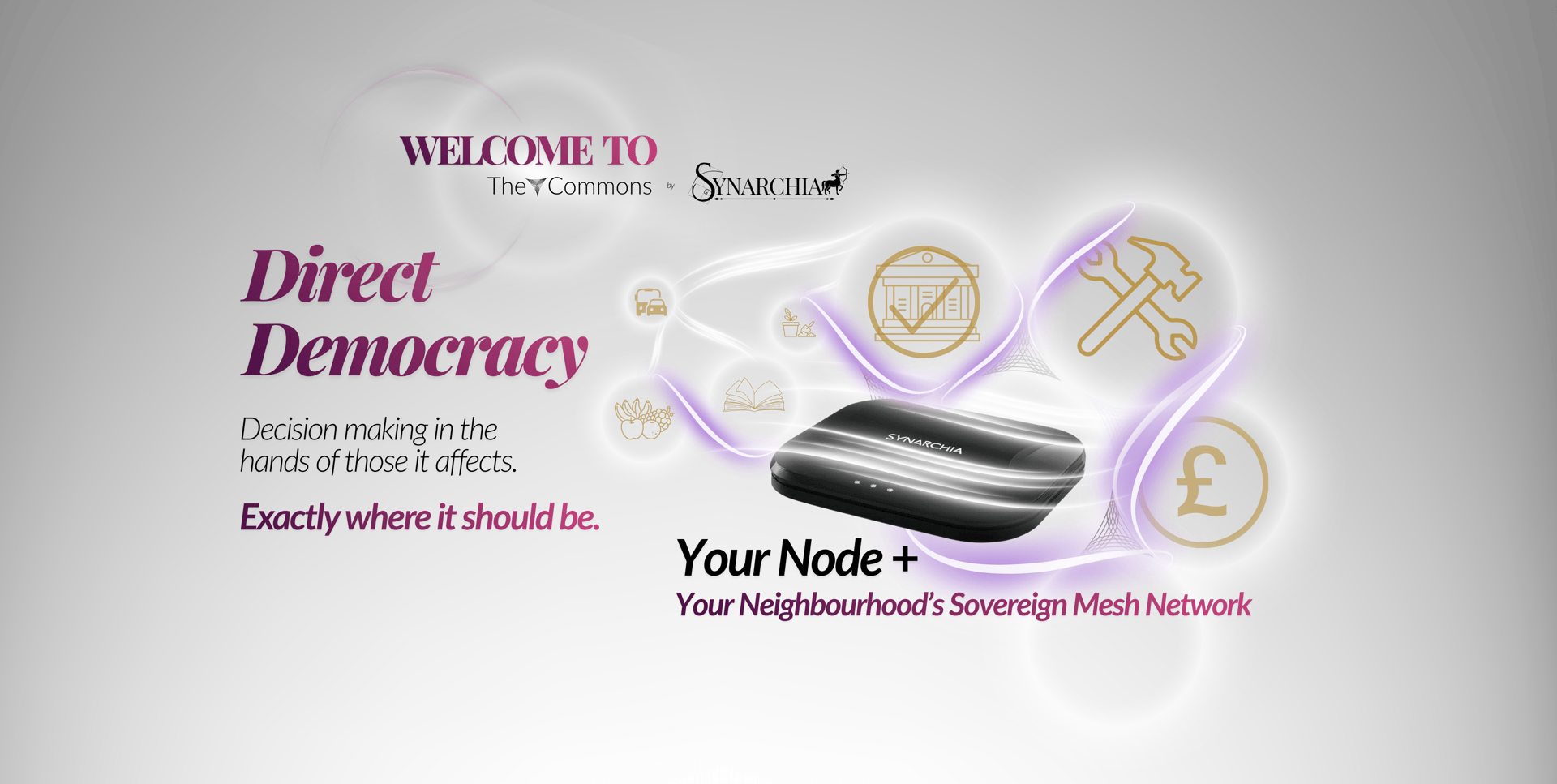

The Commons, as a hybrid online-offline framework, is a shared, decentralised, civic infrastructure that lets a community collectively manage its resources, decisions, and responsibilities.
Every participant becomes a node in a decentralised network, enabling voting, community suggestions, listing and sourcing.
It's governance with common sense, freedom, and autonomy baked into the core.
As constituents, it is our responsibility to actively invest time and energy into our communities to make them the best they can be, however without harmonious systems that aid efficiency, modern living does not always enable us to do so.
Utilising Technology and skills already available to us, we are able to create a new structure of how our Communities operate and how we experience life within that community.
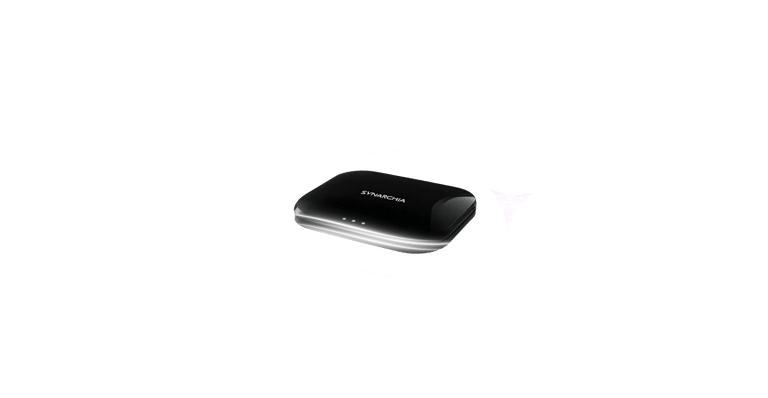
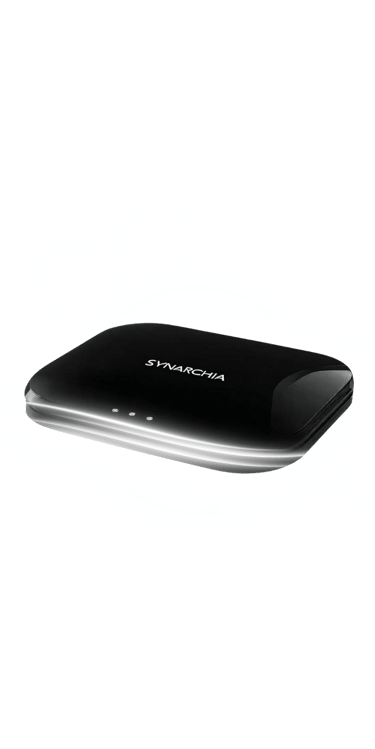
Creating a mesh network within our own communities - with every household and public venue possessing a device to create a node - we can create a decentralised network where every voice doesn't just matter, it actually impacts the immediate community - autonomously.
A fusion of Technology with Community - all while retaining personal autonomy. It's your own community super-centre, built and owned by You.
Imagine a focal point for every constituent offering the following functionality:
Stay up to date on local events - Refuse collection, Community Events, Planned and unplanned road closures
Borrow tools from your community
Source fresh local produce and handmade crafts
Vote on County-wide, and Locality, focused Governance & Fiscal decisions.
View Open Ledger of public spending (Public Purse)
View current balances of Locality Trust Funds and County-Based Trust Funds (Public Purse)
Report road works efficiently
Identify local medical assistance for an array of medical therapies
The best part? Everything on the network goes no further than the local community, there's no AI, no advertising (and no cookies tracking your behaviour), no data sold to corporations and all on a decentralised network putting your autonomy at the centre of it all.
A node in a network is essentially a local infrastructure point connecting a stream of nodes, forming a network. It is through this network that the nodes can communicate with each other, providing access to digital and physical resources:
Access to food: coordinating community fridges, local farms, or bulk purchasing
Community deliberation & governance: digital platforms for proposals, voting, and discussion
Public transport coordination: Booking onto local public transport
Tool libraries / borrowing systems: tracking, sharing, and scheduling physical resources
Technologically, the node functions as a distributed ledger or digital commons, facilitating cooperation without centralised oversight. The Commons operates as a parallel, and efficiency-improving, service to in-person.
Feedback Loops and Emergence
Emergent autonomy relies on feedback loops. Technology strengthens them:
Input → Network → Action → Feedback → Adaptation
Example: Residents propose borrowing a tool; the node shows availability and prior usage; the community adjusts rules for fairness; next cycle reflects improved norms.
This continuous loop allows autonomy to be both individual and collective. The technology doesn’t dictate outcomes—it facilitates the self-organisation process.
A neighbourhood node acts as a catalyst for emergent autonomy:
It doesn’t grant autonomy—it scaffolds it.
It makes collective self-organisation practical at scale.
Autonomy emerges through use, experimentation, and mutual adaptation.
Protecting your Privacy
Logging onto a technological framework should not cost you your autonomy, but should be a facilitator of it.
In order to balance privacy with technology, we require certain safeguards in the form of:
DID (Decentralised ID)
Instead of Personal Information, each user/network node is issued it's own ID.
Limited Personal Information
Only essential information is put onto the platform.
Security checks for in-person transactions, verified with technology
Collecting goods and services requires the scanning of a QR code, verifying somebody is who they say they are. This is linked to your DID so no personal information exchanges hands - retaining it in your possession until you wish to share.
Disconnected from the Internet
The Commons is an independent network limited to the boundaries of your locality (Maximum County Level), operating as an entirely separate network. No information is able to be input to the WWW.
No AI
With an entirely separate network built from the ground up, it retains separation from any coding and links to AI.
A fundamental point to the utilisation of Technology with physical reality is accessibility for all.
In addition to a home-based node, The Commons Network Nodes can be placed across public buildings and in Public vicinity.
For Constituents, who do not use technology at home, public points of access (PPOA) should be available in permanent placements such as Coffee Shops, Pubs, Post-offices - any business that wishes to install a Node.
With decentralised networks, the more nodes that are installed, the stronger the network (and less prone to cyber attacks taking down the whole system), and more likely the participation from the community - imagine going to meet a friend for a coffee, and then easily voting on whether a playground should receive funding, or reporting a road maintenance issue you encountered on your way.
Essentially, the node amplifies emergent autonomy by:
Reducing friction in coordination
Making interactions transparent
Providing real-time feedback loops
Allowing experimentation and iteration without central control


Get in touch
Communications@synarchia.co.uk