Use a desktop computer for the best viewing experience of Synarchia
Synarchia Economy
Personal Autonomy is stifled while you're indebted.
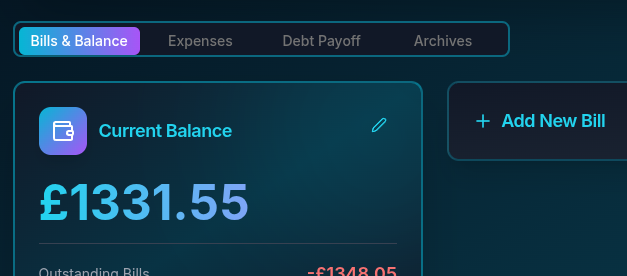
We've created a tool to help you take control of your finances*
Budget for the month ahead
Track your spending
Calculate Debt Repayments & automatic priority
It's free with no download required.
External Budgeting Tool Disclaimer
The link provided will open in a new tab or window to an external website. Account registration may be required to access its features. Synarchia, Synarchia Finance, and CountyPay are not financial advisers. Financial advice should always be sought from qualified legal and financial professionals. We provide access to our budgeting and financial planning tools to help users manage their finances more effectively. While we take reasonable care to ensure the accuracy and reliability of the information and features provided, we cannot guarantee that all data, calculations, or projections will be free from errors or omissions. The budgeting tool is intended for general guidance and educational purposes only and should not be considered financial, legal, or tax advice. Users remain solely responsible for their financial decisions and any outcomes resulting from their use of the tool. We strongly recommend that users seek independent advice from qualified financial professionals before making any significant financial decisions or relying on the information provided through this platform. We accept no liability for any loss, damage, or inconvenience arising from reliance on the tool or the information it provides.
Having the weight of debt on your shoulders carries great detriment. While many often choose to bury their heads, the best approach is radical acceptance and Conscious action.
PersonalFinance
Sovereignty-Centred Economic Framework Blueprint
A Practical System for Autonomy, Stability & Self-Determination
This blueprint outlines an alternative economic architecture designed to enhance personal sovereignty, community resilience, and long-term stability. The expanded sections now include legal pathways, operational toolkits, financial transition strategies, governance mechanics, and pilot implementation steps.
Core Philosophy
Principle Shift
From:
Dependence through scarcity
Compliance through insecurity
Growth at any cost
To:
Capability through stability
Participation through dignity
Regeneration over extraction
Sovereign Foundations Layer (Universal Security Base)
1. Universal Life Infrastructure (ULI)
Guaranteed access to food, energy, housing, water, healthcare, and digital connectivity.
Delivery through National Sovereignty Fund, local provisioning hubs, and cooperative management.
Outcome: individuals can negotiate work from choice, not desperation.
Legal Pathway:
Codify ULI as a statutory right.
National and local government cooperation for funding and enforcement.
Regulatory oversight to ensure compliance and equitable access.
Distributed Economic Control
Community Fiscal Councils (CFCs)
Control 20–40% of local tax revenue.
Direct investment portfolios and local infrastructure projects.
Participatory decision-making and transparency via digital platforms.
Governance Mechanics:
Citizen-elected councils.
Quarterly audits by independent community oversight committees.
Participatory budgeting and legal recognition under devolved powers.
IV. Parallel Value Systems
3. Mutual Credit & Local Currency Networks
Local currencies, skill-exchange credit, and time-banking systems.
Anti-fraud ledgers and public accountability portals.
Builds resilience independent of national currency fluctuations.
Community Operational Toolkit:
Simple digital wallets for local currency.
Platforms for skill exchange listings and scheduling.
Guidelines for trust and credit scoring within the community.
V. Ownership Transformation
4. Citizen-Owned Infrastructure
Cooperative ownership of energy, water, transport, broadband, and waste systems.
Governance: one citizen, one vote; dividends reinvested locally.
Community oversight boards enforce accountability.
Pilot Launch:
Begin with selected utility cooperatives in urban and rural regions.
Monitor efficiency, community participation, and service stability.
Expand successful models nationwide.
VI. Financial System Reform
5. Public Banking & Ethical Credit
Zero-interest loans for necessities and small enterprises.
Caps on private lending interest and debt jubilee mechanisms.
Supports financial sovereignty and prevents exploitation.
Financial Transition Strategy:
Gradual introduction alongside existing banking.
Seed funding via Sovereign Foundations and regional revenue shares.
Parallel operation until sufficient adoption is reached.
VII. Regenerative Economic Cycle
6. Regeneration Incentives
Tax and subsidy focus on repair, reuse, soil and food system regeneration.
Shift tax from labor to resource depletion, pollution, and speculation.
Operational Toolkit:
Guidelines for local regenerative enterprises.
Incentive frameworks for repair and circular economy projects.
Monitoring tools to track local resource sustainability metrics.
VIII. Sovereign Tax Framework
7. Autonomy-Based Tax Hierarchy
Primary taxes: land value, monopolistic profit, financial speculation, environmental harm.
Reduced tax burden on human labor, microenterprise, and cooperatives.
Legal Pathway:
Legislative reforms at national level.
Pilot programs to adjust local tax codes.
Oversight commissions to ensure fairness and compliance.
IX. Life Security Accounts
8. Personal Sovereignty Fund (PSF)
Lifelong account for education, health, career transitions, caregiving, and enterprise.
Transparent management with citizen planning.
Governance & Operation:
Account management by independent public agencies.
Community advisory boards for allocation and oversight.
Integration with local credit and resource systems.
X. Community Self-Governance Charters
9. Charters
Define local values, resource-sharing agreements, conflict mediation, and development priorities.
Recognised under devolved legal authority and national law.
Governance Mechanics:
Charter ratification through citizen assemblies.
Legal enforcement powers for community decisions.
Periodic review cycles to adapt to evolving needs.
Pilot Implementation Framework
Phase 1: Foundation Pilots
Launch ULI and PSF in select regions.
Establish first Community Fiscal Councils.
Deploy mutual credit and local currencies.
Phase 2: Structural Shift
Introduce public banking and cooperative utilities.
Begin tax code adjustments to favour autonomy.
Phase 3: Sovereign Integration
Legal recognition of self-governance charters.
National scale deployment of all systems.
Ongoing monitoring and adjustment of metrics.
Metrics of Success
Autonomy Index: measures individual choice and control.
Community Resilience Score: local economic stability and adaptability.
Well-being Stability Index: social and psychological security.
Resource Regeneration Index: ecological sustainability.
Cultural Shift
Citizens become stewards of resources and community.
Workers become contributors, not coerced labourers.
State becomes enabler, not controller.
Final Vision
A society where individuals are empowered, communities are resilient, and stability is grounded in shared responsibility and meaningful participation. The blueprint provides a structured pathway from pilot programs to nationwide implementation, creating a truly sovereignty-centered economic system.